


All Products
-
Stainless Steel Strip
-
Stainless Steel Sheet
-
Stainless Steel Plate
-
Stainless Steel Pipe
-
Stainless Steel Bar
-
Galvanized Steel Coil
-
Steel Plate
-
Steel Round Bar
-
Nickel Alloy
-
Seamless Steel Pipe
-
Stainless Steel Beam
-
Copper Plate Sheet
-
Copper Round Bar
-
stainless steel round bar
-
stainless steel channel bar
-
stainless steel angle bar
-
stainless steel coil strip
-
stainless steel flat bar
-
stainless steel circle
-
Pipe Fitting
-
Water Ripple Stainless Steel Sheet
-
Nickel Alloy and Super Alloy
-
cold rolled steel coil
-
copper
-
Nickel Base Alloy Products
-
Others
-
 Raian IonescuMaterial quality very good. we have cooperate more than 10 Years. They trade lots kinds of steel material. All material quality good. They duty for all material quality. We are planing continue cooperate with them in the future
316Ti Grade Hot Rolled Stainless Steel Plate with Polished Surface in Standard Sizes


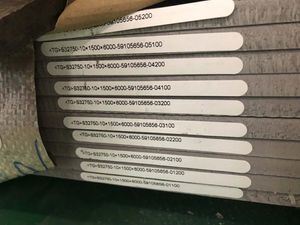





Product Details
| Shape | Round | Technique | Hot Rolled |
|---|---|---|---|
| Surface Treatment | Polished | Thickness Range | 0.6 - 30.0mm |
| Standard Size | 1219*2438mm, 1500*6000mm | Carbon Content | 0.08max |
| Manganese Content | 2.0 | Phosphorus Content | 0.045 |
| Sulfur Content | 0.030 | Silicon Content | 1.0 |
| Chromium Content | 16.0-18.0 | Nickel Content | 10.0-14.0 |
| Molybdenum Content | 2.0-3.0 | Titanium Content | 0.70 Max |
| Yield Strength | 220 MPa | ||
| Highlight | 316Ti Grade Stainless Steel Plate,Hot Rolled SS Plate,Polished Surface 316Ti Stainless Steel Plate |
||
Product Description
ASTM JIS DIN GB Grade 316 / 316L / 316H / 316Ti Stainless Steel Plate
Product Specifications
| Product Name | Stainless Steel Plate |
| Grade | 316Ti / S31635 / 1.4571 |
| Thickness Range | Cold Rolled: 0.6 - 3.0mm, Hot Rolled: 4.0 - 30.0mm |
| Standard Size | Cold Rolled: 1219×2438mm, Hot Rolled: 1500×6000mm |
| Standard | ASTM A240 / JIS G4305 / EN 10088-2 |
| Brand | TISCO, POSCO, JISCO, LISCO, DONGTE, BAOSTEEL |
| MOQ | 1 PCS |
| Service | Cutting |
About 316Ti Stainless Steel
Stainless steel types 1.4401 and 1.4404 are also known as grades 316 and 316L respectively. Grade 316 is an austenitic grade second only to 304 in commercial importance. 316 stainless steel contains an addition of molybdenum that provides improved corrosion resistance, particularly for pitting and crevice corrosion in chloride environments.
316L, the low carbon version of 316 stainless steel, is immune to grain boundary carbide precipitation (sensitization), making it suitable for heavy gauge (over 6mm) welded components. For elevated temperature applications, the high carbon variant 316H stainless steel and the stabilized grade 316Ti stainless steel should be employed.
The austenitic structure of 316 stainless steel provides excellent toughness, even at cryogenic temperatures. Property data is typical for flat rolled products covered by ASTM A240/A240M.
Stainless steel grade 316Ti contains approximately 0.5% titanium. The titanium atoms stabilize the structure at temperatures over 800°C, preventing carbide precipitation at grain boundaries and protecting the metal from corrosion. The main advantage of 316Ti is its ability to withstand higher temperatures for longer periods without sensitization occurring, while retaining physical and mechanical properties similar to standard 316 grades.
Chemical Composition of 316Ti Stainless Steel
| Element | 316Ti (1.4571) |
|---|---|
| C | 0.08 max |
| Mn | 2.0 |
| P | 0.045 |
| S | 0.030 |
| Si | 1.0 |
| Cr | 16.0-18.0 |
| Ni | 10.0-14.0 |
| Mo | 2.0-3.0 |
| Ti | 0.70 max |
Applications of 316Ti Stainless Steel
- Food processing equipment
- Brewery equipment
- Chemical and petrochemical equipment
- Laboratory benches & equipment
- Coastal architectural panelling
- Coastal balustrading
- Boat fittings
- Chemical transportation containers
- Heat exchangers
- Mining screens
Why Choose 316Ti Stainless Steel
316Ti is commonly specified in European equipment manufacturing and design standards, though it is practically non-existent in North American inventory and typically requires mill production runs.
Titanium serves as a stabilizing element in austenitic stainless steels with higher carbon contents, reducing chromium carbide formation and improving weld corrosion resistance in higher carbon grades. While 316Ti is the titanium-stabilized version of 316 (similar to how 321 relates to 304), it remains less common than 316/316L in many regions.
Design Allowable Values (ASME Sec VIII Div 1)
| Grade | 500°F | 850°F | 1200°F | 1500°F |
|---|---|---|---|---|
| 316L | 10.9 | 9.4 | NP | NP |
| 316 | 13.3 | 11.6 | 7.4 | 1.3 |
| 316Ti | 13.2 | 11.7 | 7.4 | 1.3 |
| 316H | 13.3 | 11.6 | 7.4 | 1.3 |
For typical aqueous corrosion applications, there is no advantage to 316Ti over dual certified 316/316L. For high temperature service (above 1000°F), there is no advantage in using 316Ti compared to 316H. However, in processes encountering both elevated temperatures and aqueous corrosion (such as catalytic cracking and hydrodesulfurization in petroleum refining), stabilized grades may be warranted.
Product Images

Recommended Products